
Helicopter Wake Turbulence: What Light-Aircraft Pilots Need to Know
Table of Contents
A helicopter can leave turbulence strong enough to overturn a light aeroplane, including after it has moved clear of the runway. A hovering helicopter sends downwash out across the ground; in forward flight it leaves trailing vortices. Before taking off or landing, consider where the helicopter has been and where the wind can carry its wake. FAA AIM 7-4
This is an everyday mixed-traffic problem, not something confined to large transport helicopters. The practical questions are whether your path crosses the affected air and whether you still have a safe way to wait, change the sequence or discontinue the approach. The principles apply internationally; use the local procedures and ATC instructions for the airport concerned.
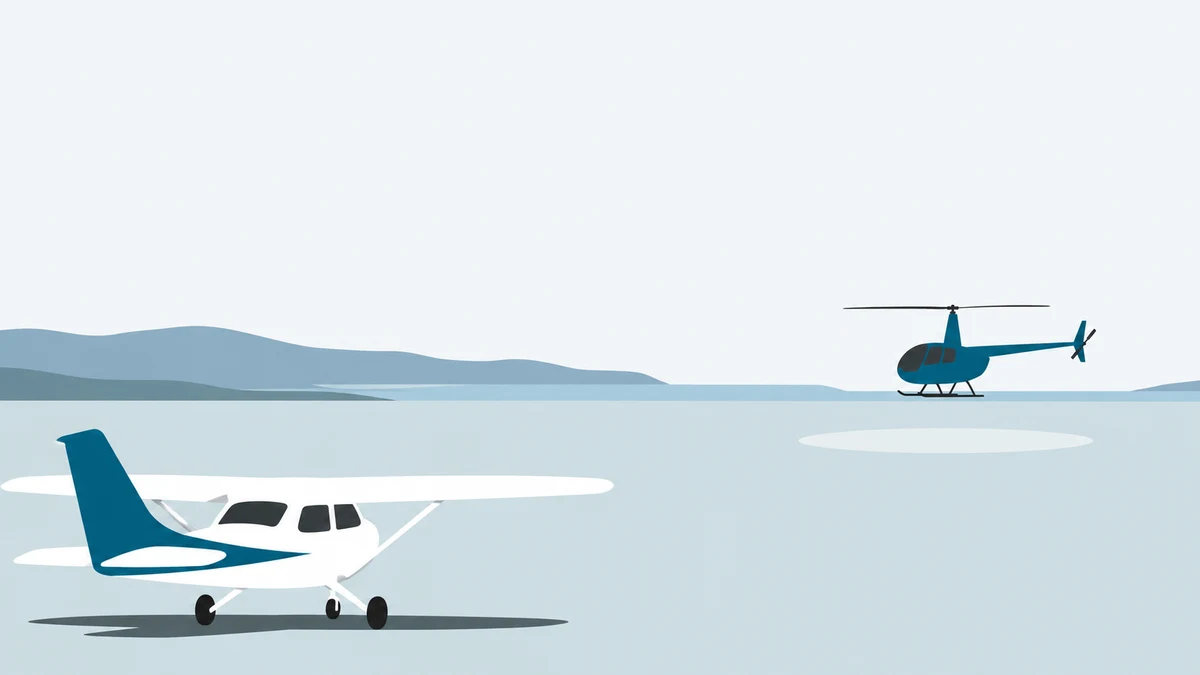
A clear runway can still contain a helicopter's wake
At Shoreham in July 2016, a Robinson R44 hover-taxied across a grass runway. About two minutes later, a Piper Super Cub took off. Its pilot corrected an initial wing drop, but could not stop the subsequent roll before a wing struck the ground.
The AAIB found that the uneven surface probably made the Cub airborne below its normal takeoff speed. Light winds allowed the helicopter's wake to persist and move across and along the runway. The investigation concluded that a low-speed wake encounter was the most probable cause of the uncontrollable wing drop. AAIB investigation, G-AXLZ
The two minutes describe that accident. They are not a waiting period after which the runway becomes safe. Nor does an empty strip of grass tell you what is happening in the air just above it.
Hovering and forward flight create different pictures
When a helicopter hovers close to the surface, its rotor pushes air downwards. On reaching the ground, that flow spreads outwards. The aircraft does not need to travel along your runway to affect it: hover-taxiing across it, or operating beside it, can matter.
In forward flight, the helicopter leaves a pair of trailing vortices. A light aeroplane following behind or crossing its recent flight path can encounter them. The wake can impose a roll that exceeds the aeroplane's available roll control. FAA AIM 7-4-1 and 7-4-7
| Helicopter activity | What the light-aircraft pilot needs to picture |
|---|---|
| Stationary hover near the surface | Air spreading away from the rotor, including towards nearby aircraft |
| Hover-taxi across a runway | The crossing point and the affected air left along the route |
| Takeoff or approach | Trailing wake along the helicopter's flight path |
| Cruise ahead of you | Wake behind the helicopter and the risk of crossing below its track |
Looking only at the helicopter's current position misses its earlier path. Keep both in your mental picture while listening to the other pilot's calls.
What the separation guidance actually covers
For a stationary hover or slow hover-taxi, the FAA AIM advises small aircraft to avoid operating within three rotor diameters of the helicopter. The NTSB's Safety Alert SA-096 also recommends at least three miles behind a cruising helicopter and three rotor diameters from a hovering one. Those are different situations, with different units. FAA helicopter guidance · NTSB SA-096
Do not turn the hover guidance into a fixed circle guaranteed to contain all turbulence. Wind, height, speed and the helicopter's previous movement affect where the disturbed air travels. Equally, a distance behind a cruising helicopter does not prescribe a waiting time after one crosses a runway.
At a towered airport, comply with the applicable separation and clearance requirements and ask for more spacing when needed. At a non-towered airport, coordinate your intentions clearly. In either setting, make the decision before a short takeoff run or final approach removes your useful options.
Use the wind to question your planned path
A helicopter off to one side may still be upwind of your runway. A light wind can leave wake near the landing or takeoff area; another wind direction can carry it into an adjacent path. The NTSB specifically highlights calm conditions and wake drifting from nearby operations or sinking from a crossing flight path. NTSB wake-avoidance advice
For example, imagine you are ready to depart while a helicopter hover-taxis across the departure end. Ask where it crossed relative to the point at which you expect to become airborne. Then consider the wind over the time you would spend lining up and accelerating. If the picture remains uncertain, holding in a suitable position preserves an option that disappears once you start the takeoff.
Do not try to calculate a precise safe departure time by dividing the distance by a reported surface wind. The wake has structure and can persist or move in ways that a simple drift calculation cannot establish. The wind is information for the decision, not a stopwatch setting.
Make the decision early on approach
An approach becomes harder to change when the aircraft is close to the ground and slow. If a helicopter crosses ahead, or your final approach would pass through its recent path, consider discontinuing the approach early while keeping clear of the suspected wake and other traffic. Advise ATC or make the appropriate traffic call.
A 2022 accident at Indiana, Pennsylvania, illustrates why a crossing matters. A helicopter passed several hundred feet ahead of a light sport aeroplane on short final. The aeroplane encountered rotor wash, rolled inverted and struck the runway. The NTSB includes the accident in its warning that helicopters and small GA aircraft can create serious wake hazards. NTSB SA-096, ERA22LA304
Avoid improvising a late, steep approach or a much longer landing to get around the problem. Any revised touchdown point still has to leave enough runway for the landing. A displaced threshold may already have reduced the distance available from your direction.
Brief the traffic you may meet
Before a first visit to an airfield, look for helicopter schools, sightseeing operations or a helipad beside the runway. These are useful prompts for the arrival briefing, particularly on a busy cross-country flight.
Before entering the runway or committing to the approach, make three checks: where the helicopter is, where it has recently flown or hovered, and whether the wind could bring that disturbed air into your path. If you need a delay, say so plainly. A short explanation such as “holding for helicopter wake” helps the other pilots understand the sequence you intend.
Frequently asked questions
Can a small helicopter upset a small aeroplane?
Yes. Size alone is a poor reason to dismiss the risk. The Shoreham accident involved a light R44 and a Super Cub; the relative aircraft characteristics and encounter conditions mattered.
Is waiting two minutes always enough?
No universal two-minute rule follows from these sources. Apply the relevant local separation procedures and assess the helicopter's movement, wind and your flight path. The Shoreham encounter occurred about two minutes after a hover-taxi crossing.
Is being outside three rotor diameters a guarantee?
No. That FAA guidance addresses operating near stationary or slowly hover-taxiing helicopters. It does not guarantee protection from a wake that has drifted across your runway or from a helicopter's earlier forward-flight path.