
Displaced Threshold: Can You Take Off on the Arrows?
Table of Contents
Yes, normally: the usable runway before a displaced threshold can form part of the takeoff run and the landing rollout from the opposite direction. It is not available for touchdown when you approach that displaced threshold. FAA guidance states that distinction directly; EASA's declared-distance guidance likewise treats a threshold displacement as reducing the landing distance in the affected direction. Check the published distances and restrictions before using the surface. FAA AIM 2-3-3 · EASA GM1 ADR.OPS.A.005, declared distances
At an unfamiliar airfield, the long stretch of pavement before the runway number can be surprisingly persuasive. From the cockpit it looks like runway, because it often is. The useful question is which part you may use for the manoeuvre you are about to make. Settle that before you reach the holding point, while there is time to unfold the chart and nobody is waiting for your departure.

Read the white arrows and threshold bar together
A displaced threshold moves the beginning of the landing area along an otherwise usable runway. In FAA markings, white arrows lead towards a broad white bar across the runway, with arrowheads immediately before it. The bar marks the start of the runway available for landing from that direction.
The practical distinction is between arriving over the arrows and rolling along them. On approach, fly to the landing area beyond the threshold. When departing, the arrow-marked portion may be part of your takeoff run. After landing from the other end, it may be part of your rollout. Any NOTAM, closure or specific airport restriction still applies. FAA runway markings
| Planned movement | Use of the portion before the displaced threshold |
|---|---|
| Landing towards the displaced threshold | Fly over it; touch down beyond the threshold |
| Taking off in that direction | Normally available for the takeoff run |
| Taking off in the opposite direction | Normally available |
| Landing from the opposite end | Normally available for rollout |
The threshold is not an aiming point. An aircraft can cross it airborne at an appropriate height and touch down farther along the landing area. Trying to put the wheels on the threshold to save runway confuses two different parts of the landing.
What the EASA markings and distances tell you
At aerodromes using EASA's certification specifications, CS ADR-DSN.L.535 provides the familiar arrows and transverse stripe for a displaced threshold. It also covers temporary displacement, including obscuring the earlier markings and turning the preceding centre line into arrows. The broad idea is familiar to a pilot arriving from the US, but a temporary layout needs its own briefing. EASA threshold-marking specifications
EASA's GM1 ADR.OPS.A.005 explains the distance consequence: the displacement reduces LDA towards that threshold, while the declared distances in the reciprocal direction are unaffected by the displacement itself. It does not automatically remove the arrow-marked section from the takeoff run. Additional closures or restrictions are a separate matter, so use the aerodrome's actual figures. EASA declared-distance guidance
For a European stop, open the national AIP aerodrome entry, its chart and the current NOTAMs together. Find the declared distances for the runway direction you intend to use. Smaller airfields may operate under national standards; the airport's current information still needs to agree with the surface in front of you.
Why the threshold may be farther down the runway
A displaced threshold can keep an arriving aircraft farther from an obstacle on the approach. EASA's CS and GM1 ADR-DSN.B.030 also address displacement associated with an unserviceable runway section. Those are different situations for the pilot: a surface that can support a takeoff run is not the same as one closed for repairs. EASA runway-threshold location guidance
That is a useful detail to discuss with a student before arrival. Identify the threshold, the intended touchdown area and any approach obstacles on the briefing material. A neat strip of tarmac before the threshold is no invitation to flatten the approach and land early. If the available landing distance does not suit the aircraft and conditions, choose another option while you still have time.
Yellow chevrons do not give the same permission
In FAA markings, yellow chevrons mark pavement unavailable for normal taxiing, takeoff or landing. It may be a blast pad, stopway or another protected area. Its position in line with the runway can make it look like spare takeoff distance from the cockpit.
A relocated threshold also needs separate attention. Construction or another temporary condition may close the runway portion before a new threshold. FAA guidance says that portion is unavailable for aircraft use; old markings may remain visible. A white bar by itself therefore does not settle the question. Read the NOTAM and the airport's current instructions. FAA AIM 2-3-3, relocated thresholds and chevrons
Before lining up, compare the actual surface with the diagram you briefed. If the picture does not agree, stop somewhere safe and resolve it with ATC or the airport operator. An unexplained marking deserves a question while the aircraft is stationary.
Use the distance for the operation you are planning
The airport's headline runway length is not necessarily the distance available for every performance calculation. Where declared distances are published, use them. The four abbreviations answer different questions:
| Distance | What it describes |
|---|---|
| TORA: takeoff run available | Runway suitable for the takeoff ground run |
| TODA: takeoff distance available | TORA plus any qualifying clearway or remaining runway included in the published figure |
| ASDA: accelerate-stop distance available | Distance available for the applicable rejected-takeoff calculation |
| LDA: landing distance available | Runway available for the landing performance calculation |
Do not add a visible paved extension to a published distance yourself. Safety-area requirements can shorten declared distances without placing another painted line on the surface. A clearway, meanwhile, is not extra pavement for your wheels. FAA AIM 4-3-6, declared distances
A 3,000-foot runway, worked through both ways
Imagine a fictional Runway 09/27 with 3,000 ft of usable pavement. Runway 09's threshold is displaced 500 ft. For this example, assume there are no other restrictions and the published figures are:
| Direction | TORA | LDA |
|---|---|---|
| Runway 09 | 3,000 ft | 2,500 ft |
| Runway 27 | 3,000 ft | 3,000 ft |
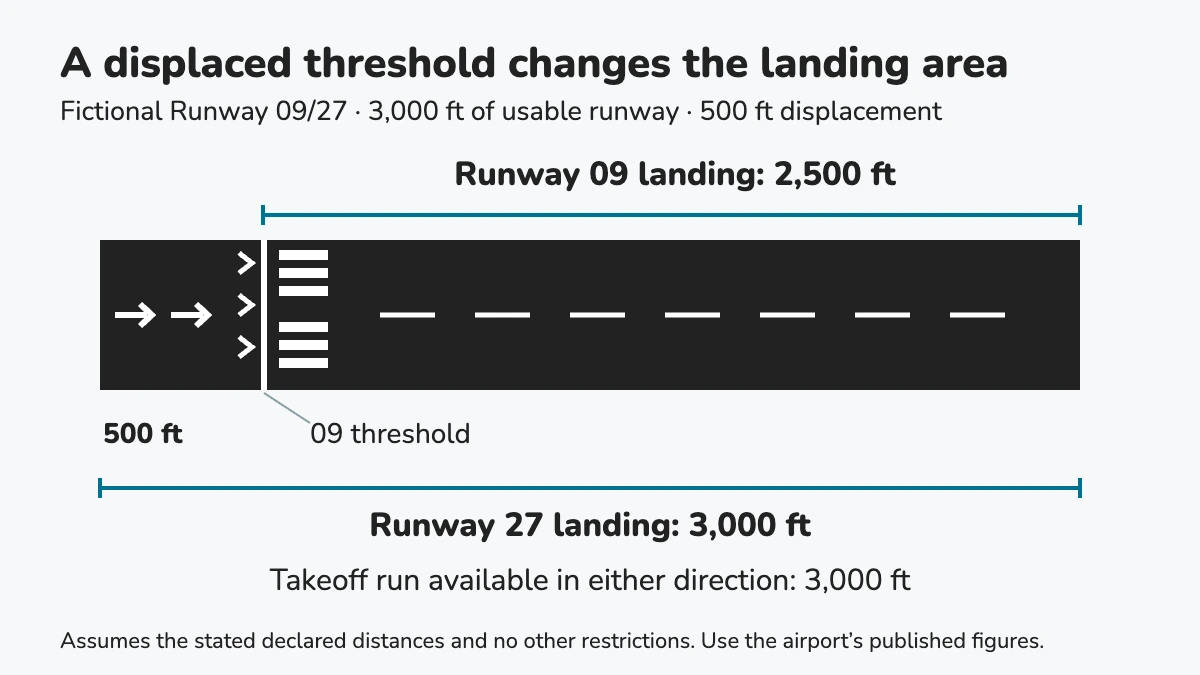
On a Runway 09 arrival, the first 500 ft passes beneath you before you reach the landing threshold. Assess the landing against the 2,500 ft LDA. For a Runway 09 departure from the runway beginning, the arrow-marked 500 ft contributes to the 3,000 ft TORA.
Landing on Runway 27 reverses the picture. Those arrows are near the far end, and the aircraft may roll onto that portion after touchdown. They do not create an automatic stopping line for the opposite-direction landing.
This is a teaching example, not a method for reconstructing an airport's declared distances. Starting from an intersection would introduce another change: the takeoff distance remaining from that intersection.
Put the threshold in your arrival briefing
For a US airport, open the current FAA Chart Supplement, alongside the diagram and NOTAMs. For an EASA aerodrome, use the national AIP and current aerodrome information. Read the distances for the intended direction and departure point, including any published intersection figures. Check the units against those in the aircraft's performance data.
For each planned stop on a cross-country flight, record the runway direction, landing threshold, applicable distances and any construction. Then compare the available landing distance with the aircraft's performance for the expected conditions and your chosen margin.
A useful briefing is short enough to remember. For the fictional Runway 09 above, it might be: “Landing starts beyond the displaced threshold; 2,500 feet available. The arrows are available for departure from the full-length starting point.” Then add your approach plan and go-around decision. If the wind changes and you use Runway 27, revisit the figures rather than carrying the first briefing across unchanged.
Brief the departure too, especially if the aircraft will be heavier after a fuel stop. Being able to taxi over the arrows answers a surface-use question. Having sufficient takeoff and climb performance requires a separate calculation.
Frequently asked questions
Can you taxi on the white arrows?
At a normal displaced threshold, the arrow-marked runway portion is usable surface. Follow the airport's taxi procedure and obtain any required runway clearance. Confirm that it is not a closed or temporarily relocated-threshold area.
Where do I find the threshold displacement?
Check the current airport entry, runway diagram and NOTAMs. Read the displacement together with the landing distance for the runway direction you intend to use; a photograph of the arrows is not enough to establish either distance.
Does a displaced threshold always reduce takeoff distance?
No. FAA and EASA guidance distinguish the landing threshold from the usable takeoff surface. Displacement reduces the landing distance in the affected direction; takeoff distance may remain unchanged. Use the applicable published distance and departure point, including any temporary restriction.