
Climb Gradient to Feet per Minute: Formula and Worked Examples
Table of Contents
Required climb rate in feet per minute = climb gradient in feet per nautical mile × groundspeed in knots ÷ 60. For a gradient of 300 ft/NM at 90 knots groundspeed, the result is 450 ft/min.
The calculation converts a slope over the ground into a rate you can compare with aircraft performance. It works wherever those units are used; the departure-procedure examples here follow FAA terminology. The FAA publishes the same relationship in its Instrument Procedures Handbook, Chapter 1, Figure 1-17.

What a climb gradient measures
A gradient of 300 ft/NM means gaining 300 feet of height for every nautical mile travelled horizontally over the ground. Rate of climb measures height gained per minute. You need groundspeed to connect them.
At 60 knots, you cover one nautical mile each minute, so 300 ft/NM requires 300 ft/min. At 120 knots, you cover two nautical miles each minute and need 600 ft/min to follow the same slope. A healthy-looking vertical speed indication means little until you know how quickly the aircraft is passing over the ground beneath it.
Read the complete departure requirement before calculating. A gradient may apply only until a specified altitude or fix. Route, turns, crossing restrictions and obstacle notes remain part of the procedure. FAA AIM 5-2-9, Instrument Departure Procedures
Convert ft/NM to ft/min
Use these three inputs for a hypothetical departure:
- Required gradient: 300 ft/NM.
- Planned groundspeed during the relevant climb: 90 kt.
- Conversion from hours to minutes: 60.
First convert speed: 90 ÷ 60 = 1.5 NM per minute. Then multiply: 300 × 1.5 = 450 ft/min.
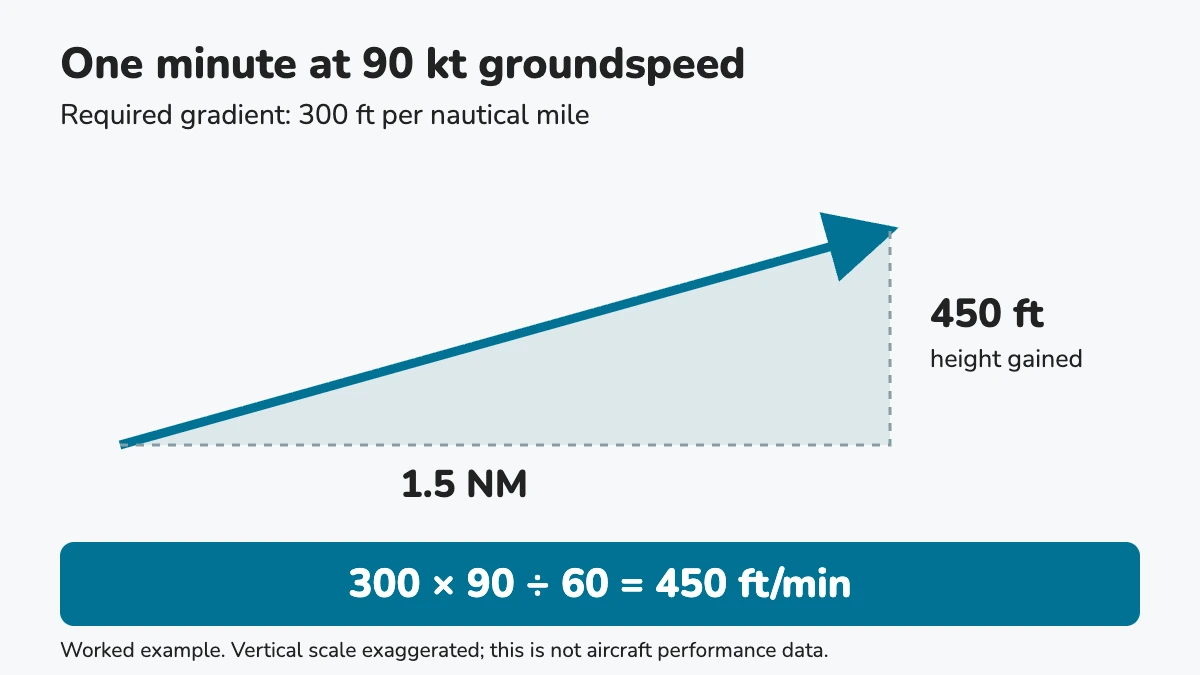
The units explain why the formula works:
ft/NM × NM/min = ft/min
Keep the distinction between indicated airspeed, true airspeed and groundspeed. The aircraft's climb schedule may specify an indicated airspeed. The gradient conversion uses the resulting speed over the ground, after allowing for altitude and wind.
A climb-gradient conversion table
These values are calculated directly from the formula. Groundspeed is across the top; the required vertical speed is in the body of the table. They are arithmetic examples, not aircraft performance figures.
| Required gradient | 60 kt GS | 80 kt GS | 90 kt GS | 100 kt GS | 120 kt GS |
|---|---|---|---|---|---|
| 200 ft/NM | 200 ft/min | 267 ft/min | 300 ft/min | 333 ft/min | 400 ft/min |
| 250 ft/NM | 250 ft/min | 333 ft/min | 375 ft/min | 417 ft/min | 500 ft/min |
| 300 ft/NM | 300 ft/min | 400 ft/min | 450 ft/min | 500 ft/min | 600 ft/min |
| 400 ft/NM | 400 ft/min | 533 ft/min | 600 ft/min | 667 ft/min | 800 ft/min |
| 500 ft/NM | 500 ft/min | 667 ft/min | 750 ft/min | 833 ft/min | 1,000 ft/min |
Non-integer results are rounded to the nearest foot per minute for display. Retain precision in planning and leave an appropriate performance margin. Current FAA chart specifications include a rate-of-climb table with ft/NM, percent and groundspeed columns; check which units a chart uses before choosing a row.
Convert a percentage gradient
A percentage expresses vertical rise divided by horizontal distance, with both distances in the same units. A 5% gradient gains 5 units vertically for every 100 units horizontally.
One nautical mile is approximately 6,076.12 feet, so:
Gradient in ft/NM = gradient in percent × 60.7612
For a 5% gradient:
- 5 × 60.7612 = 303.806 ft/NM.
- At 90 kt groundspeed, 303.806 × 90 ÷ 60 = 455.709 ft/min.
- The mathematical requirement is therefore approximately 456 ft/min.
Enter 5, not 0.05, in that percentage formula. If you use the decimal fraction 0.05, multiply it by the full 6,076.12 feet per nautical mile instead.
A gradient in percent is also different from an angle in degrees. Five percent corresponds to about 2.86°, not 5°. Use the column heading, rather than the apparent size of the number, to identify the quantity.
Why a tailwind changes the answer
Consider an aeroplane climbing at 90 kt true airspeed directly along the wind direction. For this simplified example, assume it can sustain 600 ft/min and the departure requires 300 ft/NM.
| Wind component | Groundspeed | Required climb rate | Margin above that rate |
|---|---|---|---|
| 20 kt headwind | 70 kt | 350 ft/min | 250 ft/min |
| Calm | 90 kt | 450 ft/min | 150 ft/min |
| 20 kt tailwind | 110 kt | 550 ft/min | 50 ft/min |
The assumed climb rate through the air has stayed the same. With a tailwind, the aircraft reaches the next obstacle sooner, so it must gain height faster to maintain the required gradient over the ground.
Real departures may turn, and winds change with height. Calculate the relevant segments using suitable forecast groundspeeds. Do not carry a favourable headwind assumption around a turn into a tailwind.
Check what the aircraft can actually deliver
The conversion establishes the required rate. The AFM or POH establishes the performance available at the planned mass, pressure altitude, temperature and configuration. Check the entire altitude band over which the gradient applies. A climb rate available near the runway may have fallen substantially before the gradient ends.
For another hypothetical example, an aircraft sustaining 500 ft/min at 100 kt groundspeed achieves:
Achieved gradient = 500 × 60 ÷ 100 = 300 ft/NM
That matches a 300 ft/NM requirement mathematically, with no allowance for performance shortfalls. It does not establish a comfortable operational margin.
Follow the published airspeed and configuration for the performance data you use. Pulling the nose up to chase a vertical-speed target can reduce airspeed and does not create extra climb capability. If performance is insufficient, change the departure plan before takeoff: the route, timing, loading or aircraft may need to change.
A published IFR departure is not an engine-failure escape plan. The FAA AIM's departure guidance distinguishes procedure obstacle assessment from one-engine-inoperative performance planning. Keep those calculations separate.
For a longer trip, make this check part of the departure planning described in our 300 NM cross-country guide, alongside runway distance, fuel and weather.
Frequently asked questions
Is 200 ft/NM the same as 200 ft/min?
Only at 60 kt groundspeed. At 90 kt it requires 300 ft/min; at 120 kt it requires 400 ft/min. A gradient must always be paired with groundspeed before it becomes a climb rate.
Can I use indicated airspeed in the formula?
Use groundspeed. Indicated airspeed is relevant to flying the aircraft's climb schedule, but it does not tell you how quickly you are travelling over the ground.
How do I calculate the gradient from a known climb rate?
Multiply climb rate in ft/min by 60, then divide by groundspeed in knots. For example, 600 ft/min at 120 kt is 300 ft/NM. To express that as a percentage, divide by 60.7612: approximately 4.94%.
Does meeting the rate guarantee obstacle clearance?
The number alone does not. You must also comply with the procedure's route, altitudes, turns and other conditions, and establish that the aircraft can sustain the necessary performance. A calculation based on the wrong groundspeed or flight configuration cannot establish that.