
Hobbs vs Tach Time: What Goes in Your Pilot Logbook?
Table of Contents
For your pilot logbook, use the flight time defined by the rules that apply to you. A Hobbs or tach reading is useful evidence, but the meter's name does not decide what you may log. In a normal light-aeroplane flight, EASA and FAA flight time both include the relevant taxi periods. Neither definition simply says to copy the rental invoice. EASA FCL.010 · FAA § 1.1
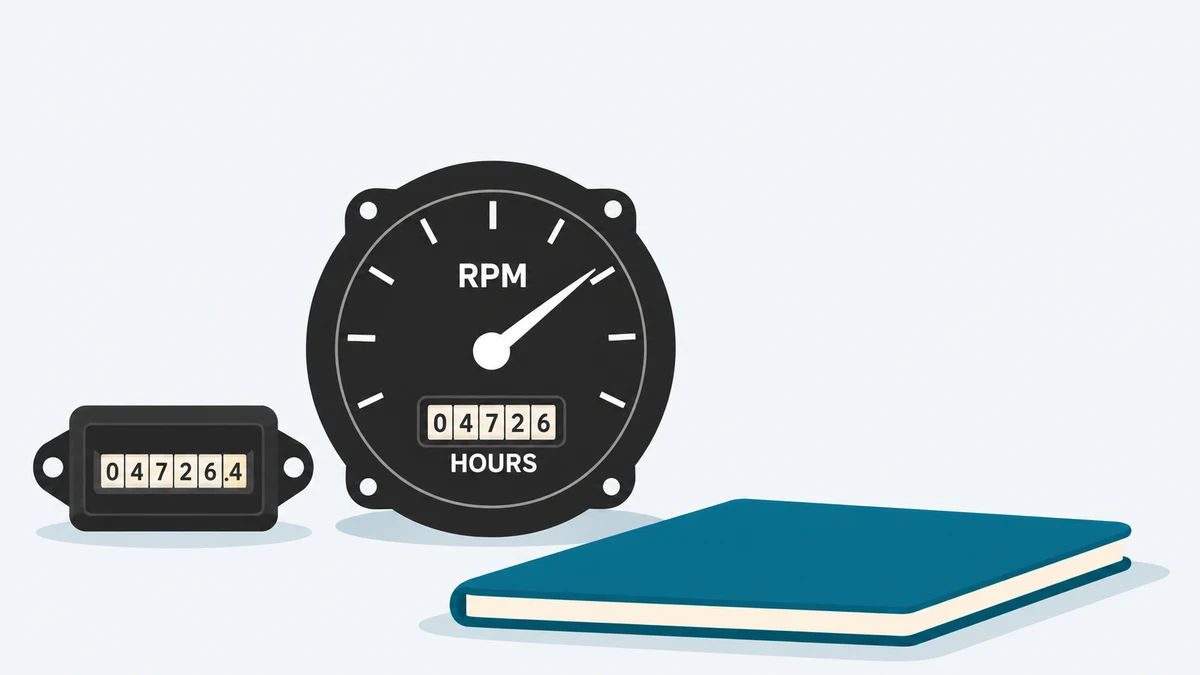
What each clock measures
Before comparing readings, find out what makes each installed timer start and stop. Two aircraft with a meter labelled “Hobbs” can have different switching arrangements.
| Term | What it describes | What to establish |
|---|---|---|
| Hobbs time | Elapsed clock time while the hour meter is running | Which switch or aircraft condition activates this installation |
| Tach time | Time accumulated by a recording tachometer, commonly related to engine RPM | The particular instrument's recording method and reference RPM |
| Block time | Time between the recorded departure and arrival ground events | Whether those events match the applicable flight-time definition |
| Airborne time | Time from takeoff to landing | Whether the record you are completing calls for airborne time |
A Hobbs installation can use an oil-pressure switch. Van's Aircraft provides a wiring example in its gauge installation instructions. Such a meter can run while you warm the engine before moving. Check your own installation instead of assuming that switching on the master always starts it.
A conventional recording tachometer accumulates time more slowly at low RPM than at its reference RPM. Orlando Christian Flying Club explains this behaviour in its tach-based rental terms. A long taxi and run-up can therefore produce a larger difference between tach and elapsed time than a flight spent mostly at cruise power. Electronic instruments may use different logic; read the instrument or aircraft documentation.
When the logbook clock starts and stops
For aeroplanes under EASA Part-FCL, flight time runs from the aircraft's first movement for the purpose of taking off until its final stop at the end of the flight. Record it in the form required by your licensing authority. FCL.010 and FCL.050
UK Part-FCL uses the same start and stop points for aeroplanes. Its FCL.010 definition retains that movement-to-final-stop wording, so the worked aeroplane example below gives the same duration under UK and EASA Part-FCL. This is a comparison of flight-time definitions, not a claim that every licensing requirement remains identical. UK FCL.010
Under FAA § 1.1, flight time begins when the aircraft moves under its own power for the purpose of flight and ends when it comes to rest after landing. The “under its own power” condition is part of the FAA wording. The example below assumes a conventional piston aeroplane that taxis under its own power at both ends. FAA flight-time definition
In that example, taxi-out, the normal run-up and holding periods after the flight has begun, and taxi-in fall inside the flight-time interval. Engine running before the first qualifying movement, or after the final stop, falls outside it. An engine start on its own does not start this aeroplane logbook clock.
These definitions concern the duration of the flight. Your entitlement to log it as PIC, dual or another function is a separate question. If two pilots share the aircraft, work through the PIC logging examples before allocating the minutes.
One flight, four different totals
This is a fictional local flight, using one time zone and an oil-pressure-activated Hobbs meter. The pilot is appropriately rated, acts as PIC and operates the controls throughout.
| Event | Clock time |
|---|---|
| Engine starts | 09:00 |
| Aeroplane first moves to taxi for takeoff | 09:06 |
| Takeoff | 09:14 |
| Landing | 09:58 |
| Final stop at the parking position | 10:06 |
| Engine shuts down | 10:12 |
The recorded Hobbs readings are 412.0 before and 413.2 after: a difference of 1.2 hours, or 72 minutes. The tach advances by 0.9. Those are stipulated readings for this example, not a conversion formula.
The pilot's flight-time interval is 09:06–10:06: 1:00, or 1.0 decimal hour. The airborne interval is 09:14–09:58: 44 minutes. Entering the 1.2 Hobbs difference would add 12 minutes outside the defined flight interval. Entering 0.9 tach would omit six minutes from it.
Suppose this fictional rental agreement charges US$160 per Hobbs hour, including fuel. Its aircraft-use charge is 1.2 × US$160 = US$192, before any other agreed fees or taxes. Paying for 1.2 hours does not turn the pilot's 1.0 flight hour into 1.2.
Keep minutes and decimals distinct: 1:30 is 1.5 hours, while 1.3 hours is 1 hour 18 minutes. Retain the underlying times even if your electronic logbook displays rounded decimal totals.
Do other countries count the time differently?
For the conventional aeroplane flight above, Australia and New Zealand also lead to a 1.0-hour interval. Australia's CASA explicitly includes movement whether or not it is under the aircraft's own power. New Zealand's definition expressly includes associated pushback, taxiing and subsequent holding time. That wording matters for a flight involving pushback; it does not make stationary engine warm-up before the first qualifying movement count as flight time. CASA logbook guidance · New Zealand CAA Part 1, flight time
Canada: a real difference for helicopters
An important international exception appears when you change aircraft category. EASA FCL.010 counts helicopter flight time from the start of rotor rotation until the helicopter is at rest after the flight and the rotors stop. That is a different clock from the aeroplane definition. EASA Part-FCL definition in the consolidated regulation
For a Canadian skid-equipped helicopter, Transport Canada's AC 700-052 starts the flight-time interval when the skids first leave the supporting surface. It ends at the final rest on that surface with the intention of shutdown. Intermediate stops with the pilot remaining at the controls are included. The circular explicitly rejects using rotor-start to rotor-stop time for Canadian student flight-time records. Transport Canada AC 700-052, sections 3.1–3.3
Consider a fictional flight with no intermediate stops: rotors start at 08:00, the helicopter lifts off at 08:10, lands and begins shutdown at 09:00, and the rotors stop at 09:06. That produces 1:06 under the EASA helicopter definition and 0:50 under the Canadian guidance. The same rotor-time meter would not supply the right total for both records.
This exception concerns helicopter pilot-logbook time. It does not change the aeroplane example or make Canadian helicopter flight time identical to air time: a qualifying intermediate ground stop can count in the former but not the latter.
Compare rental prices on the same basis
Real clubs use different charging arrangements. As checked on 25 November 2026, Regal Air publishes fuel-inclusive rates based on Hobbs time rounded up to a tenth. Orlando Christian Flying Club publishes dry rates based on tach time, with fuel paid separately. These are examples of contracts, rather than rules for all rental aircraft. Regal Air rental terms · Orlando Christian Flying Club rates
Ask a school to price the same representative lesson, including taxi time, fuel, instruction and landing fees. A cheaper displayed hourly rate can produce a higher final bill. The pilot licence cost guide covers the other items to include.
Keep enough evidence to explain the entry
Write down departure and arrival events while they are fresh. Photograph or note both meter readings if the club requires them, and keep those readings separate from the pilot logbook total. If they differ unexpectedly, ask which timer is being used and how it is triggered before copying a number.
For an FAA record used for qualifications or currency, § 61.51 requires details including the date, flight time, departure and arrival locations, aircraft identification, pilot experience and flight conditions. EASA FCL.050 requires a reliable flight record in the authority's prescribed form. A rental receipt does not capture all of that information. FAA § 61.51 · EASA recording requirements
FAQ
Can I multiply tach time by 1.2 to get logbook time?
A fixed multiplier cannot reconstruct the actual interval reliably. The difference depends on the instrument and the flight's power settings. Use recorded start and stop events, supported by the aircraft's records, to establish flight time.
Does taxi time count as flight time?
For the normal aeroplane flight described here, yes: the qualifying taxi-out and taxi-in are inside the EASA and FAA flight-time intervals. Taxiing an aircraft between parking areas for maintenance is a different activity; the purpose-of-flight condition still matters.
Is the aircraft maintenance record the same as my pilot logbook?
No. FAA § 1.1 separately defines time in service for maintenance records, using the interval from leaving the surface until touching down at the next landing. Follow the aircraft's approved maintenance-recording arrangements. A familiar meter reading should not be assumed to mean the same thing in every record. FAA § 1.1, time in service